Panasonic Camera Control System User Guide
Introduction
1. About the Camera Control System
The Camera Control System enables you to adjust lens iris, camera paint (shading), and all camera menu settings on supported Panasonic cameras.
The Camera Control Panel is an easy-to-use software interface that runs within Ross Video’s DashBoard application. Multiple cameras can be adjusted from a single workstation.
Your system may also include an optional Camera Paint Box, which features physical knobs for adjusting iris and paint controls (gains and pedestals).
The Camera Control system can be set up as part of a Ross Robotics system, or as a standalone camera control station.
Starting the Camera Control System
2. Connect and Turn On All Components
Ensure that the following are connected and turned on:
-
Control Computer. Depending on your system, this may be a dedicated computer, or a SmartShell Computer that also controls a Ross Robotics system.
-
Network switch
-
Serial to Ethernet converter(s) (Comtrol units)
-
Panasonic cameras and accessories
-
Camera Paint Box (if equipped)
-
Ross Robotics System components (if equipped)
For information about how to set up the Camera Control System, see the Panasonic Camera Control System Installation Guide (8351DR-008-xx) .
3. Start the Camera Control Panel
Start the Camera Control Panel
The Camera Control Panel is accessible through a node in the DashBoard component tree.
-
In DashBoard, navigate to the node that contains the cameras you want to control. Expand any camera node.
-
Double-click Remote Control.
-
The Camera Control Panel appears.
tipThe panel is designed for full-screen mode on a 1920x1080 display. To turn full-screen mode on or off, press Shift + F11 .
Camera Control Features
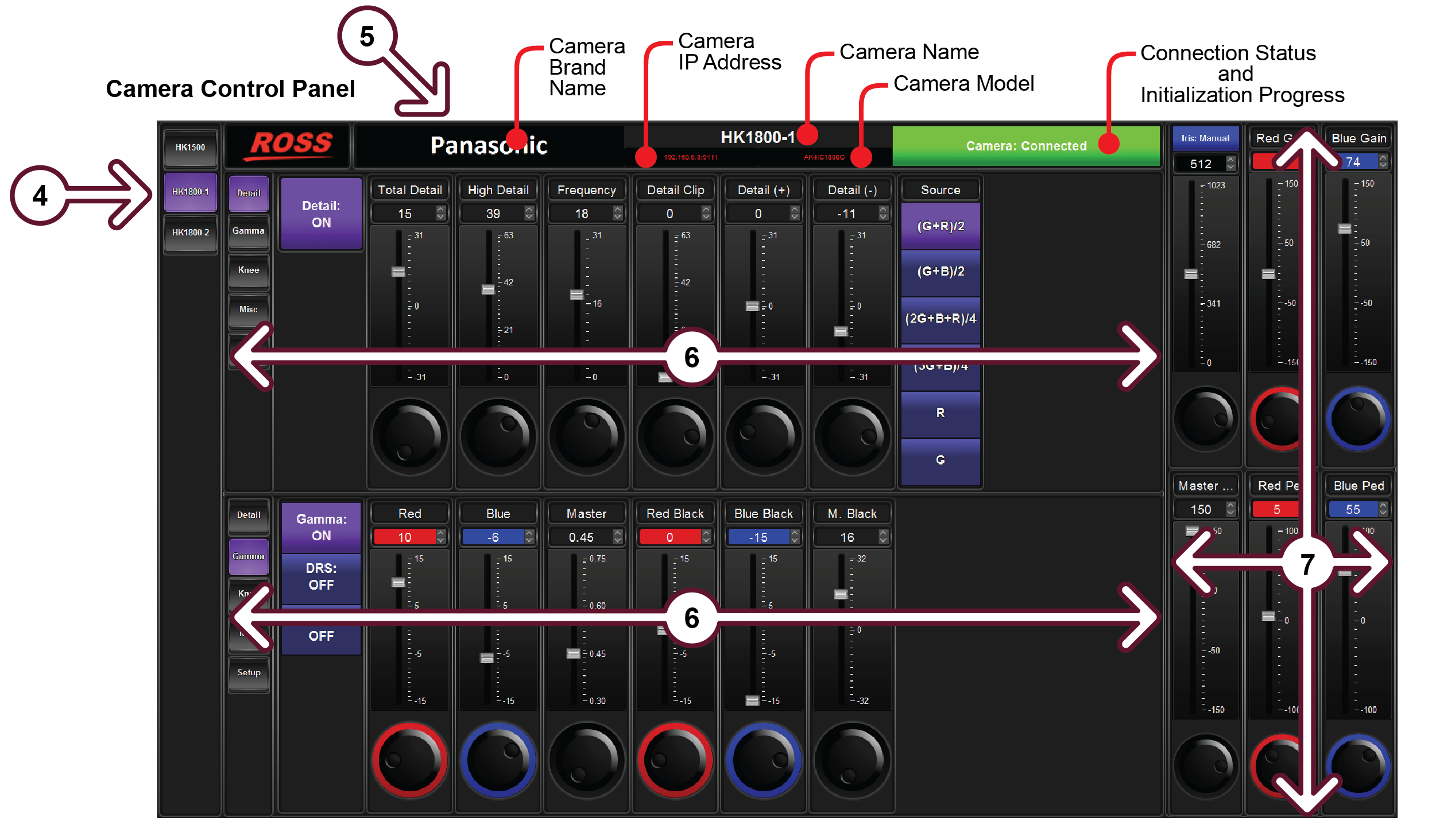
Figure 1
4. Camera Selection Area
Tap a camera button to select and configure that camera. The button turns purple. If the camera is connected, the panel shows configuration values for the camera.
Cameras must be initialized. If the red Camera: Disconnected button is visible at the top of the panel, tap it to initialize the camera. After the camera initializes, the camera button changes to display Camera: Connected .
If your system includes a Camera Paint Box, it can control iris and paint settings for the selected camera.
If your system is integrated with the SmartShell robotic control application, and SmartShell is configured for Selection Follow, selecting a camera in any interface selects it in all others. For example, if you select a camera on the joystick panel, it is also selected in SmartShell and in the Camera Control Panel .
You can turn the Selection Follow feature on or off for each Control Computer in your system:
-
Open the DashBoard Component Tree , navigate to DashBoard Services , and then double-tap Selector UI Mappings .
-
In the Selection Mapping panel, do one of the following:
• To turn Selection Follow ON , tap the UI Follows Selection ON button.
• To turn Selection Follow OFF , tap the UI Follows Selection OFF button.
5. Connection Status Bar
The connection status bar appears along the top of the panel, and shows the following items related to the selected camera:
- Brand name (Panasonic)
- IP address (configured during initial setup)
- Name (configured during initial setup)
- Model number
- Connection status. Tap to connect or disconnect the selected camera. While the camera is initializing, the panel shows initialization progress.
6. Camera Control Areas (Upper & Lower)
Each Camera Control Area (upper and lower) displays one group of controls at a time. On the left side of each area, tap one of the following buttons to select the group of controls to display:
- Detail
- Gamma
- Knee
- Misc — The miscellaneous (Misc ) group includes white balance, shutter mode, shutter speed, camera gain, and filter settings.
- Setup — This group includes controls related to camera setup, and enables you to navigate through all on-screen camera control menus. For more information see Section 12 .
Purple buttons indicate selected options.
7. Iris and Paint Controls

Figure 2
Iris and paint controls include the following:
-
Iris — When set for manual control, the Iris value selector adjusts lens iris.
The Iris button indicates Auto or Manual control. The iris can be controlled only if the Iris button is set to Manual . To switch between Auto and Manual , tap the Iris button.noteIf iris control is set to Manual and then camera power is disconnected and reconnected, iris control reverts to Auto mode but the Iris button still says Manual . To regain manual iris control, tap the Iris button to change it to Auto , and then tap it again to change it to Manual .
importantThe lens has a physical switch to enable either automatic or manual iris control (A or M ). To control iris using the Camera Control System, the switch must be set to automatic (A ).
-
Master Pedestal (also known as Master Black )
-
Red Gain
-
Red Pedestal
-
Blue Gain
-
Blue Pedestal
8. Camera Paint Box (Optional Accessory)
Camera Paint Box settings include the following:
- Iris — The lens has a switch to enable either automatic or manual iris control (A or M). To control iris using the Camera Paint Box, the switch must be set to automatic (A).
- RED GAIN
- RED PED — Red pedestal.
- BLUE GAIN
- BLUE PED — Blue pedestal
- MASTER PED — Master pedestal, also known as Master Black
- Note : GREEN GAIN and GREEN PED (green pedestal) are not operational.
- Each knob on the Camera Paint Box adjusts two settings, one at a time. The names of the settings appear above and below the knobs. To switch between the upper group or lower group of settings, flip the UPPER / LOWER switch.
- Tip : When you turn a knob on the Camera Paint Box, you can view the resulting value in the Camera Control Panel .
Camera Control Panel - Groups of Controls
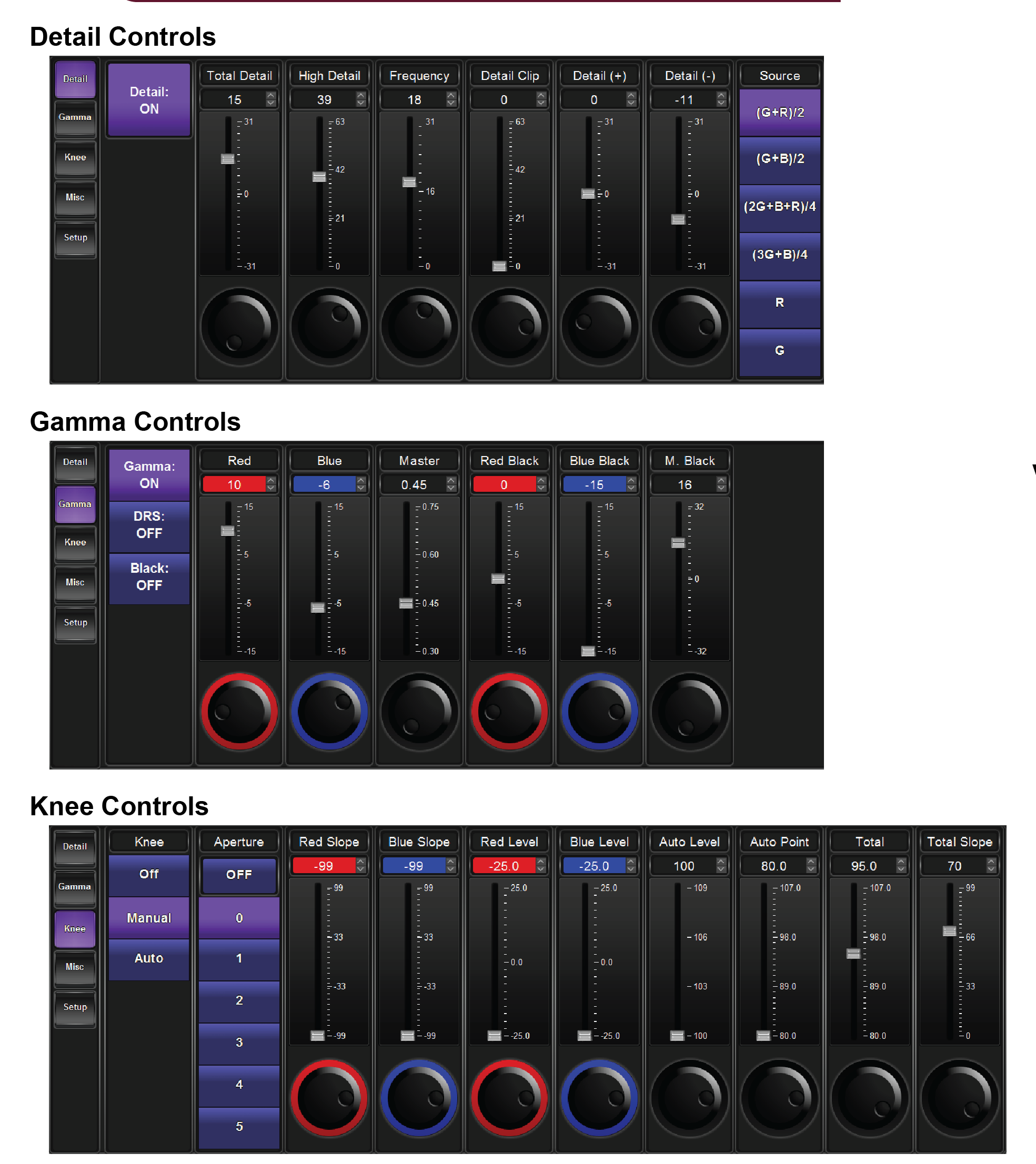
Figure 3
9. Groups of Controls Available in the Camera Control Areas
The upper and lower camera control areas can display any two of five groups of controls: Detail , Gamma , Knee , Miscellaneous , and Setup (camera setup).
This page shows the five groups of controls, describes typical control interfaces (value selectors and button options), and explains how to configure camera settings using on-screen camera menus.
Camera Control Panel - Types of Controls
9. Value Selectors
The text box at the top of each value selector displays the name of the setting.
Value selectors enable you to specify values in four ways:
- Text Value- Tap the text box, type a value, and then press Enter.
- Up / Down Arrows- Tap the up arrow or down arrow to increase or decrease the value.
- Slider- Drag the slider handle up or down, or tap the vertical scale, to increase or decrease the value.
- Touch Wheel- Tap and hold the touch wheel, and then trace along the edge of the wheel to increase or decrease the value.
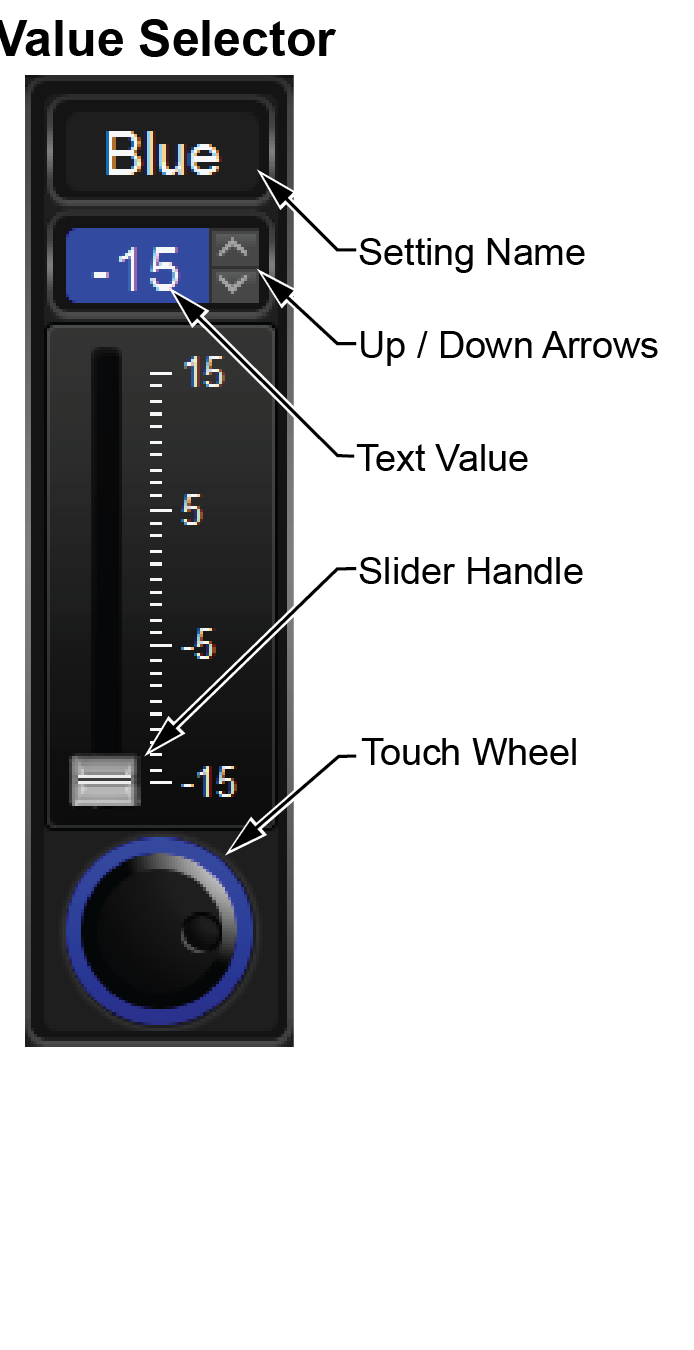
Figure 4
11. Button Options
Many settings in the Camera Control panel are presented as buttons. Tap a button to select the option it represents.
Purple buttons indicate selected options.
Blue buttons indicate unselected options.
Blurred button text indicates options that cannot currently be changed. For example, in Setup controls, you cannot turn test bars on if the menus are locked. In this case, Bars: OFF is shown in blurred text (see picture of Setup Controls ).
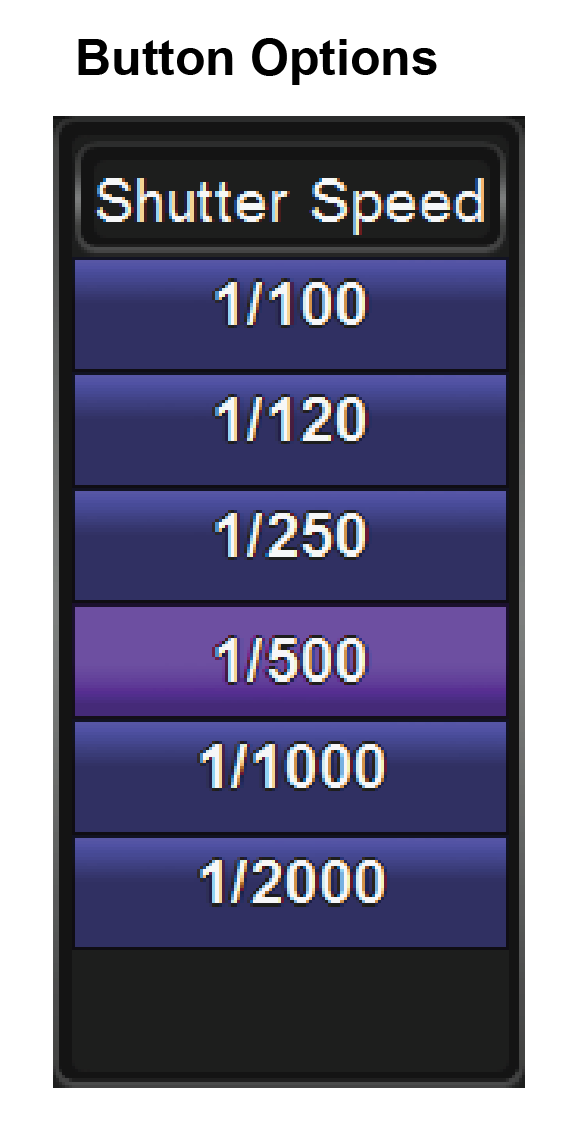
Figure 5
Configuring Camera Settings Using On-Screen Camera Menus
11. Configure Camera Settings Using On-Screen Menus
Figure 6
-
For the camera you want to configure, route the camera’s video output to a video monitor you can see. You must be able to see the on-screen menus to use them.
-
In the Camera Control Panel , select the camera, ensure it is connected, and then tap the Setup button.
-
If the button at the bottom of the Menus/Bars area is red (Menus: Locked ), tap it to unlock the menus.
-
If the Menus: OFF button is visible, tap it so it changes to Menus: ON . The on-screen camera menu appears on the video monitor.
-
Navigate the on-screen menu, and configure settings as desired:
- In the on-screen menu, an arrow points to the current item. Tap the up and down arrows in the Camera Control Panel to move the on-screen arrow to the desired item.
- To select the current item, tap the Enter button in the Camera Control Panel .
- If the selected item has submenu options, those options appear. Select an option and then tap Enter .
- When a value is flashing, it is editable. Tap the up and down arrows to select a value, then tap Enter to set the value.
- For text values, an on-screen arrow points down towards the current character. Use the up and down arrows to move the arrow to the character you want to edit, and then tap Enter to make the letter flash. Tap the up and down arrows to select a character, and then tap Enter to set it. When the entire text value is correct, move the arrow to point to the colon (:), and then tap Enter .
- To go to a higher level in the menu, navigate to the top item and then tap Enter .
-
When you are finished configuring camera settings using the on-screen menu, tap the Menus: ON button to turn off the menus.